


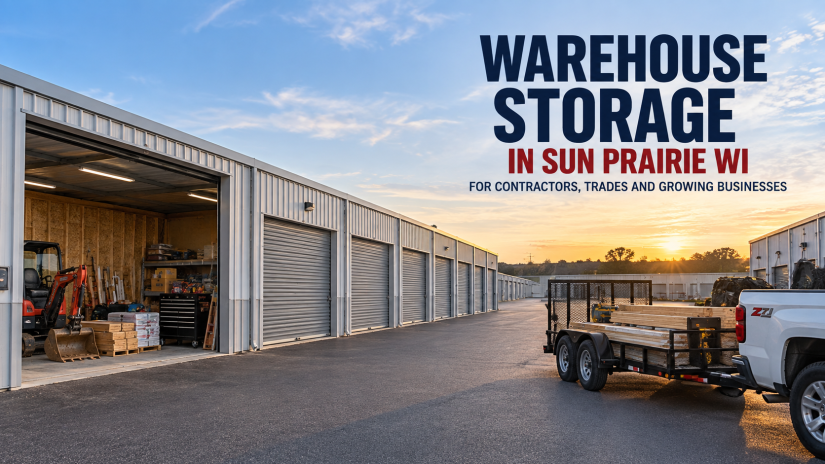


Warehouse Storage for Sun Prairie Contractors and Trades
Sun Prairie is not a small town quietly holding steady. The city is projected to grow roughly 23 percent between 2020 and 2025, and current estimates put the population near 40,000 and climbing, driven in part by continued manufacturing and technology growth the city's own economic development office points to directly. That growth means more houses being built, more commercial buildouts, more subdivisions going up on what used to be farmland on the edges of town. For the contractors, tradespeople, and small commercial operators doing that work, it also means a specific storage problem: a standard 10x20 unit stops being enough space long before the job does.
When a Regular Storage Unit Stops Being the Answer
Most storage guidance assumes a business needs somewhere between a closet and a two car garage worth of space. A roofing crew storing shingles and ladders, an HVAC company with a few spare units and some ductwork, a retailer with seasonal overflow. That is real and common, and a standard drive up unit handles it fine.
Warehouse storage is a different category of problem. A general contractor running multiple active job sites might have a skid steer, pallets of lumber or block, a trailer full of framing material, and a stack of finished materials waiting on a delivery window, all at once. A landscaping or excavation company might need to park equipment that simply does not fit through a standard drive up door. This is not a bigger version of the same need. It is a different need entirely, and it is the reason Lakestone's Sun Prairie location carries a dedicated Warehouse tier that none of our other three Wisconsin locations offer.
At a Glance
- Lakestone Storage in Sun Prairie is currently the only one of our four Wisconsin locations with a dedicated Warehouse unit tier, running from 12 by 22 feet up to 36 by 25 feet.
- Sun Prairie's population has grown roughly 11 percent since 2020 and is projected to keep climbing toward 44,000, a pace tied directly to ongoing residential and commercial construction around the city.
- Warehouse spaces suit equipment and material volumes that outgrow a standard 10x20 drive up unit, without the cost or 12 month commitment of leasing commercial warehouse space.
- Month to month terms mean a contractor can scale space up during a busy building season and scale back down without being locked into a lease sized for the peak.
What Actually Needs Warehouse Sized Space
Multiple Pieces of Equipment, Not Just One
A single skid steer or a single trailer often fits in a large standard unit. The warehouse tier becomes the right call when a contractor is storing several pieces of equipment together, a truck and a trailer and a piece of heavy equipment, or when the equipment itself is simply too wide or too tall for a standard door.
Bulk Material Between Deliveries and Job Sites
New construction in a growing city runs on material timing. Lumber, block, roofing material, and fixtures often arrive in bulk ahead of when a crew can actually use all of it on site, especially when a contractor is juggling more than one active job. Warehouse space holds that material securely between the delivery truck and the job site, rather than leaving it exposed on a lot or paying to have it delivered twice.
Seasonal Equipment Rotation at Scale
A landscaping or excavation company running several crews accumulates a lot of seasonal equipment, mowers and trimmers in summer, plows and salt spreaders in winter, and the off season gear for both. At a small scale this fits standard storage. At the scale of a company running multiple crews across a fast growing service area, it usually does not, and warehouse space becomes the more realistic option.
A Staging Point for Multiple Active Jobs
Contractors working several sites at once in a city adding new subdivisions every year benefit from having one central, secure location to stage material and equipment rather than scattering it across job sites where theft and weather exposure are both real risks. A warehouse unit functions as that staging point, close enough to load and go, secure enough to leave equipment overnight.
What Warehouse Storage Actually Includes at Sun Prairie
The Sun Prairie Warehouse tier runs from 12 by 22 feet up through 36 by 25 feet, giving real range between a contractor who needs meaningfully more room than a standard unit and one running a larger operation with multiple vehicles and a season's worth of material. Because demand for this tier has been strong, availability runs tight at times. If the size you need shows as a waitlist, call and we will let you know realistically how soon space is likely to open, rather than leaving you guessing.
Warehouse Storage Compared to Leasing Commercial Space
For a lot of Sun Prairie contractors, the real alternative to warehouse storage is leasing a small commercial or industrial space outright. That comes with a 12 month lease at minimum, utilities, insurance, and maintenance on top of rent, and it locks you into that cost whether the season is busy or slow. Warehouse storage at Lakestone works month to month. You take the larger space when a project or a season demands it, and you are not paying for it during the slower months. For a business whose workload genuinely swings with the construction calendar, that flexibility is usually worth more than the marginally lower per square foot cost of a long term commercial lease.
What Warehouse Storage Is Not
To be direct about limits rather than overselling the space: these are not climate controlled, and they are not a substitute for a fully enclosed commercial building with utilities and a permanent address for your business. If your equipment or materials are genuinely sensitive to temperature and humidity swings over a long Wisconsin storage period, that is a different conversation, and our Temperature Controlled Storage option at our De Forest location, about twenty minutes from Sun Prairie, is worth a look for that specific subset of material. For general contractor equipment, bulk building material, and vehicles, the Warehouse tier at Sun Prairie is built for exactly that.
If Your Storage Need Is Smaller Than a Warehouse
Not every Sun Prairie business needs the largest tier. Retail overflow, a moderate equipment load, or seasonal rotation for a smaller operation often fits comfortably in our standard Business and Commercial Storage units, and our Contractor Warehouses page covers that broader range across sizes. If you are unsure which tier actually fits what you are storing, describe your equipment and material volume when you call and we will recommend the right size rather than defaulting you to the largest available option.
Planning Space Around a Building Season
Construction and trade work in a growing city does not run at a flat pace year round. Framing crews, roofers, and excavation companies typically see the heaviest volume from spring through fall, with material orders and equipment use both climbing during those months. Winter usually means less active building, but it does not mean less need for secure storage, since equipment still needs somewhere safe to sit between the last fall project and the first spring one, and plows, salt spreaders, and winter specific gear need space of their own. A contractor who sizes their storage only around summer volume often ends up either paying for unused space all winter or scrambling to find a larger unit again the following spring. Thinking about warehouse space across a full year, not just the busiest months, tends to be the more cost effective approach for a business whose workload swings with the seasons the way most Wisconsin trade work does.
Getting the Timing Right on a Delivery Heavy Job
New construction in a fast growing market often means juggling delivery schedules from several suppliers at once, lumber from one vendor, fixtures from another, roofing material on its own timeline. When those deliveries do not line up perfectly with when a crew can actually install the material, someone has to decide where it goes in the meantime. Leaving it on an active job site risks weather damage and theft, particularly for finish materials and fixtures that are expensive to replace. A warehouse unit gives a contractor a secure place to receive a delivery ahead of schedule rather than pushing the supplier to delay it, which matters more than it sounds like on a job where falling behind by even a few days on material has a way of cascading into missed deadlines further down the project.
Getting Warehouse Storage in Sun Prairie
Lakestone Storage in Sun Prairie is the only one of our four Wisconsin locations with this tier, a direct response to the volume of contractor and trade activity tied to the city's ongoing growth. Call (608) 838-1800 to describe your equipment and material needs, or browse current availability online. If you are researching business storage more broadly and want to compare it against leasing commercial space, our business storage guide near De Forest walks through that cost comparison in more detail.
FAQ
What is the difference between warehouse storage and a standard large unit?
Warehouse units at Sun Prairie run larger, from 12 by 22 feet up to 36 by 25 feet, built for multiple pieces of equipment, bulk material, or vehicles together rather than one item or a moderate equipment load.
Is warehouse storage available at every Lakestone location?
No, Sun Prairie is currently the only one of our four Wisconsin locations with a dedicated Warehouse tier.
Why is warehouse space sometimes on a waitlist?
Demand from local contractors and trades has been strong given Sun Prairie's growth. Call us directly for a realistic estimate of when space is likely to open.
Is warehouse storage climate controlled?
No. For material or equipment that is genuinely sensitive to temperature and humidity, temperature controlled storage is available at our De Forest location instead.
What size warehouse unit do I need?
It depends on how much equipment and material you are storing at once. Call and describe your setup, vehicles, equipment count, and material volume, and we will recommend a size rather than you guessing.
