


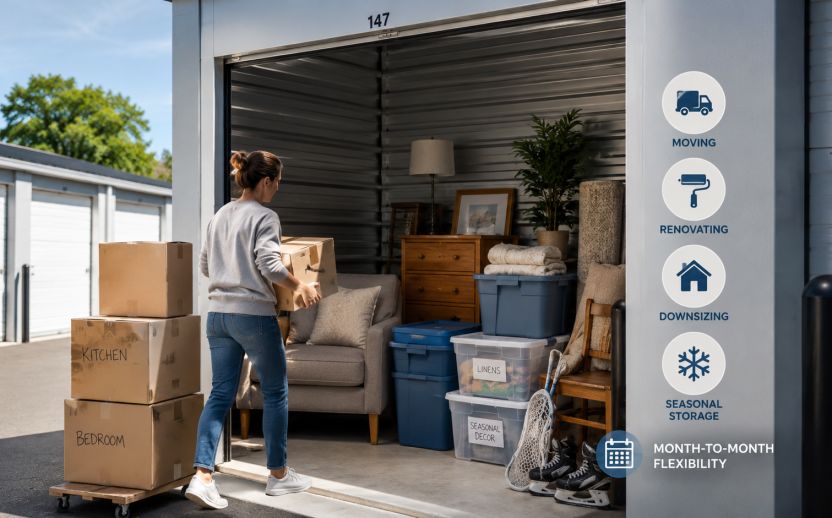
Somewhere between "we've outgrown the house" and "we're not getting rid of it," you need a place for the stuff that doesn't fit anymore.
A renovation project displaces furniture for six weeks. Your kid moves out but takes half their childhood with them. You downsize from the suburbs to a condo and suddenly your dining table doesn't fit the new layout. Or you're just tired of things piling up in the garage, basement, and attic.
Residential storage isn't about hoarding. It's about breathing room.
Lakestone Storage serves households across Wisconsin with straightforward, month-to-month storage that fits your timeline and budget. No long contracts, no surprise fees. Just clean units in a secure facility where you can access your stuff when you need it.
When households actually use residential storage
During a move or renovation
You're closing on a new house in two months, but your current place sells faster. Storage bridges the gap. Or you're gutting the kitchen and need the furniture out of the way for contractors. Rent a unit for three months, move everything back when done.
Life transitions
A divorce, a job relocation, a health situation. Sometimes you need to pare down your primary living space but aren't ready to let go of furniture, collections, or sentimental items yet. Storage gives you time to sort without the rush.
Downsizing
Your kids are grown, you're moving to a smaller place, but the dresser your grandmother left you and the leather sofa your parents gave you aren't going in the new condo. Store them until you figure out what stays and what goes.
Seasonal swaps and overflow
Holiday decorations, extra bedding, patio furniture, garden tools. Things you use three months a year and store the other nine. A residential storage unit keeps your home clutter-free without sacrificing the stuff you actually need.
What fits in residential storage
Nearly everything, as long as it's not on the banned list: no hazardous materials, no living things, and no food.
Typical household items include furniture such as couches, dining tables, dressers, and bed frames, along with mattresses and box springs. You can also store seasonal decorations, holiday gear, kitchen appliances, dishes, bedding, linens, textiles, books, artwork, framed photos, tools, power tools, hardware, sports equipment, recreational gear, children's items, toys, antiques, and collectibles.
The key is matching the unit size to what you're storing. A studio apartment's worth of furniture fits differently than a three-bedroom house's overflow.
Not sure what size you need? Our storage unit size guide helps you estimate, or call (608) 838-1800 and our team can recommend the right fit based on what you're storing.
Why month-to-month matters
If you're storing household items, you probably don't know exactly how long you'll need the space. Maybe the renovation finishes two weeks early. Maybe the house doesn't sell on schedule.
With a long-term contract, you're locked in and paying for space you don't need, or scrambling for a place if your timeline shifts.
Lakestone Storage is month-to-month across all locations. No long contracts, no penalties for moving out early. Lock in a space as long as you need it, and we just ask for a 15-day notice if you're ready to reclaim your stuff.
That flexibility is what makes residential storage actually useful instead of another financial commitment.
Standard vs. climate-controlled storage for household items
Most household items do fine in a standard drive-up or ground-level unit. Furniture, tools, sports gear, and seasonal decorations aren't picky about temperature swings.
Climate-controlled storage is worth considering if you're storing antique or solid-wood furniture, since temperature swings can cause wood to crack and joints to loosen.
It can also help protect electronics and appliances because condensation can corrode circuits. Important documents, photos, and artwork may benefit from climate control because mildew and humidity can damage paper and finishes.
Leather goods and upholstered furniture can rot, dry out, or crack because of temperature and humidity swings. Musical instruments can also be affected because wood can warp and strings and hardware can fail.
Wisconsin winters are hard on stored goods because of the freeze-thaw cycle. Things expand and contract, moisture builds up, and mildew loves a cold, damp garage or uninsulated space. Climate control keeps things steadier, which protects your stuff.
Making residential storage work
A few habits make the process smoother.
Use plastic totes instead of cardboard
Cardboard absorbs moisture and falls apart over time. Plastic totes stack, seal, and survive the season.
Label everything clearly
You're going to forget what's in that box. Write the contents on at least two sides so you can see it whether boxes are stacked or not.
Leave some airflow
Don't pack the unit floor-to-ceiling or wall-to-wall. Air circulation prevents moisture pockets and makes it easier to access things without toppling the whole stack.
Elevate boxes off the floor
Concrete can sweat, so put boxes on pallets or shelving if possible. If the floor gets damp, you don't want your stuff sitting in it.
Cover furniture with breathable cloth, not plastic
Plastic traps condensation against the fabric. A canvas drop cloth or blanket lets moisture escape while protecting from dust.
Keep an inventory
Write down what's in the unit before you leave. Sounds obvious, but it saves time when you're trying to remember if the holiday lights are in Box 12 or Box 14.
Rent residential storage online or by phone
Browse available units at any of our four Lakestone Storage locations: Cambridge, De Forest, Sun Prairie, or Stoughton, and reserve online in minutes.
Or call (608) 838-1800 and talk through your situation with someone who can help you pick the right size and location for your household storage.
Residential Storage FAQ
How much does residential storage cost?
Price depends on unit size and location. Smaller units (5x5) run less than large units (10x20), and climate-controlled storage costs more than standard storage. Browse current rates and reserve online, or call for a quote.
Can I access my stuff anytime?
Yes, during facility gate hours. You're not locked into specific visit times. Come when you need something.
Do I need climate control for household furniture?
For solid wood, antiques, electronics, or anything with upholstery, climate control is worth the extra cost to prevent cracking, mildew, and corrosion. Standard units are fine for most seasonal items and non-perishable goods.
How long can I rent for?
Month-to-month, for as long as you need. No long-term contract is required.
Do I need to buy insurance?
Yes, stored items must be insured. You can extend your homeowner's or renter's insurance, or purchase a storage protection plan through us.
Can I move in the same day I rent?
Yes. Online rentals let you move in the same day or whenever you're ready. Call to arrange access if you're moving after hours.
What happens if I want to move my stuff to a different unit?
No problem. Just let us know. We can transfer you to a different size or location as your needs change.